Garmin Approach R10 review
What the Garmin R10 measures, where it falls short, how much room it needs, and who should buy it over the MLM2PRO or Square Golf.
How we make money. If you buy through a retailer link here, we may earn a commission. It costs you nothing and doesn’t change our picks. Our affiliate disclosure.
Key takeaways
- Buy it for budget simulator golf in a room 15 ft deep with a net, 16 with a screen. Skip it if you need spin or club path you can trust.
- It costs $500 to $600. That makes it the cheapest unit we cover that runs real simulator software.
- Ball data and the Garmin app are free. Garmin Golf (about $10 a month) adds virtual courses. GSPro or E6 Connect costs extra.
- Indoors, spin is estimated and club path jumps around. In a shorter room, the Square Golf costs about the same and sits beside the ball.
Garmin Approach R10
Our verdict
Buy it if your room is at least 15 ft deep with a net (16 with a screen) and you want simulator golf for the price of a driver. Skip it if you need spin or club path numbers you can trust.
$500–$600
US retail range
What we like
- Ball speed, launch and carry for $500 to $600, and the Garmin app needs no membership
- Plays GSPro, E6 Connect, Awesome Golf and TGC 2019, the same courses as units that cost five times more
- Small enough to live in your golf bag, and it runs on its own battery at the range
- The Garmin app films your swing with your phone and matches each clip to the shot
- The cheapest sensible way into a projector-and-screen simulator
What we don’t
- Spin is estimated indoors, so wedge and driver carries can drift from what you see on the course
- It shows club path and face angle, but it works them out instead of seeing them. They jump around too much to coach from
- It needs about 7 ft behind the ball plus 8 ft of ball flight. That rules out rooms under 15 ft with a net, 16 with a screen
- Garmin's own virtual courses need the Garmin Golf membership, and GSPro or E6 cost extra on top
On this page
What the R10 is and who it’s for
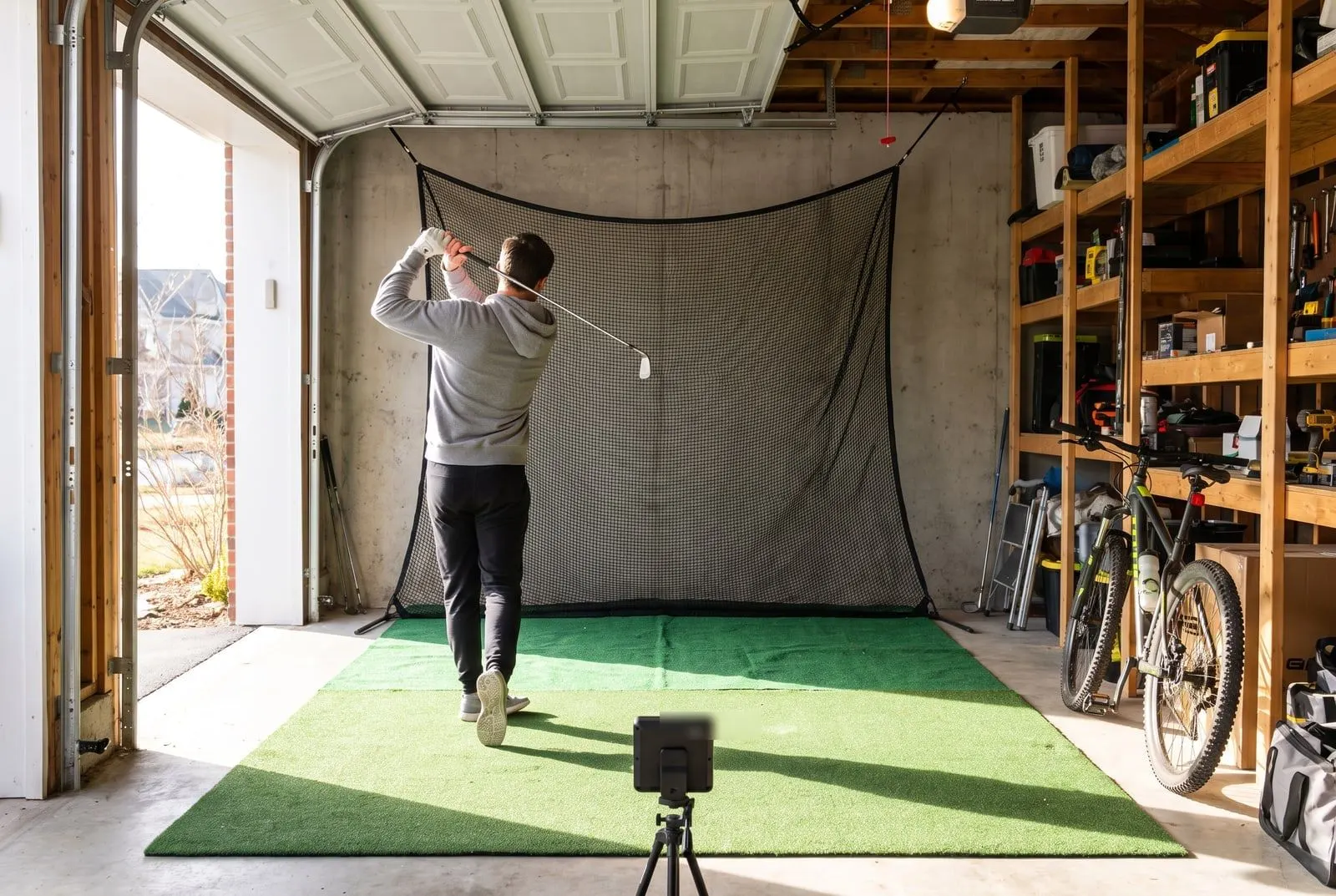
The Garmin Approach R10 is a pocket-sized radar launch monitor. That’s the gadget that measures your shot and tells the software where the ball would have gone. The R10 sits on a little tripod on the floor behind you.
It watches the ball fly, like the speed gun at a baseball game. Then it sends the numbers to the Garmin Golf app on your phone over Bluetooth. It has no screen of its own.
Street price has sat between $500 and $600 since 2025. That makes it the cheapest launch monitor we cover that runs real simulator software.
The R10 came out in 2021 as a range tool. It grew into a home simulator because Garmin opened it up to other software, and the price never went up. Five years on, it’s still the cheapest sensible first launch monitor if you’ve got a garage, a net and about $600.
Who’s it for? Golfers who want to play rounds on a screen and learn their carry distances. You’ll need at least 15 ft of depth with a net, or 16 with a screen. It also suits anyone who’d rather spend the savings on a better mat or a projector.
Skip it if you want to work on spin or club path. Skip it too if your room is a spare bedroom.
Tracking
Doppler radar
Sits
7 ft behind the ball
Room depth
15–16 ft
Ball flight needed
8 ft
Club data
Partial or estimated
Price
$500–$600
Room depth is where the maker says the unit sits, plus 8 ft of ball flight. The lower figure is with a net. The higher one adds the 1 ft gap behind an impact screen. Check your own room.
What it measures, and what it estimates
The R10 measures what a radar can see. That’s ball speed (how fast the ball leaves the club), launch angle (how steeply it takes off) and launch direction. From those, it works out carry, total distance, peak height, hang time and how far offline you went.
For a 7-iron into a net, those are the numbers that matter. They’re the R10’s strength.
Spin is estimated, not measured. Spin rate is how fast the ball spins, and it decides how high the ball climbs and how fast it stops. Outdoors, the radar gets a long look at the ball, so its spin number gets closer to the truth.
Indoors, it only sees 8 ft of flight before the net. So it guesses spin from how the ball launched. It uses a model of what a ball at that speed and angle usually does.
Owner reports follow that pattern. Wedge spin looks believable outdoors and too good to be true indoors. Driver carries can read long, where a pricier unit would show the ball spinning more.
If measured spin matters to you, the Rapsodo MLM2PRO reads it off a marked ball. That’s the main thing the extra $100 and its membership buy you.
Club data is partial. The app shows club head speed, club path (the direction the club is moving at impact) and face angle (where the clubface points). Owners call the club speed reasonable.
Path and face are the weak pair. The radar can’t see the clubface, so it works them out, and forum owners say they jump around a lot. Don’t build a swing change on them. Think of the R10 as a ball-flight tool with a club speed number attached.
The room it needs
You need 15 ft of depth with a net, or 16 ft with an impact screen. Garmin puts the R10 about 7 ft behind the ball, lined up with the target. Then it asks for at least 8 ft of ball flight before the net or screen.
How deep a room the Garmin Approach R10 needs
16 ft wall to wall with an impact screen, 15 ft with a net.
7 ftradar behind you
8 ftball flight
1 ftgap
Say your room is 14 ft deep. You’d be giving up a foot somewhere. Owners who’ve tried it report more missed shots and the odd carry number that makes no sense.
Garages and long basements pass. Spare bedrooms don’t, and neither do most single-car garages with a workbench at the back. Run your numbers through the room checker before you order.
If depth is your problem, look at a camera unit that sits beside the ball. The Square Golf costs about the same and only needs swing room behind you.
Ceiling height depends on your swing, not the radar. Our guide to how much space you need covers the ceiling and width checks for a driver. The garage simulator guide applies them to a garage.
Software and what costs extra
The free Garmin Golf app is where you’ll spend most of your practice time. It has a driving range, shot history, a few practice games and a swing-video mode that uses your phone camera. None of that needs a membership.
The Garmin Golf membership costs about $10 a month. It turns on virtual courses in Garmin’s own app. It’s the cheapest way to play a round with the R10, and it runs on a phone or tablet, so you don’t need a PC. The graphics are simple and the course list is Garmin’s own, but it works.
For a real simulator, you’ll want other software. Think of it as the “video game” part. The R10 connects to E6 Connect, GSPro (through GSPro Connect), Awesome Golf and TGC 2019.
Owner threads lean toward GSPro for its course library and its price. It needs a Windows PC. Our GSPro setup guide walks through pairing and the settings owners suggest for the R10. The software hub compares the rest, and each one is a separate license on top of the unit.
| What you want | What you need | Extra cost |
|---|---|---|
| Practice range, shot history, swing video | Garmin Golf app | None |
| Garmin’s courses on a phone or tablet | Garmin Golf membership | About $10 a month |
| GSPro on a projector and screen | Windows PC, GSPro license | GSPro yearly fee plus the PC |
| E6 Connect or Awesome Golf on an iPad | iPad, software license | Software fee |
What owners and reviewers say about accuracy
Owners and reviewers put ball speed and launch angle close to units that cost thousands more. They call iron carries good enough to build a yardage chart from. Driver carries read a little long indoors, which fits with the estimated spin.
Two complaints keep coming up. The first is misreads on short shots. Chips and half wedges indoors don’t give the radar much to watch, so it sometimes misses them or shows a strange number.
The second is phantom shots, where the unit records a shot you never hit. It happens when something else moves through the radar’s view, like a practice swing close to the ball. The usual fix in owner threads is to step back for practice swings.
Both problems ease as the ball gets more room to fly. That’s one more reason to give it the full 8 ft.
Reviewers also agree the R10 is better outdoors. At the range, with a full flight to watch, the spin estimate improves and carries tighten up.
Setting it up as a simulator
The simplest build is the R10 on its tripod, a net, a mat and your phone in the clip or on a stand. Hang a TV on the wall that shows your phone’s screen, and you’re playing Garmin’s courses. Beyond the unit, you only pay for the net and the mat.
The full build adds an impact screen (the tough fabric screen you hit into), a short-throw projector and a Windows PC running GSPro. A short-throw projector makes a big picture from only a few feet away. In this build, you pair the R10 to the PC instead of your phone.
The radar doesn’t mind a screen. But the screen has to be at least 8 ft from the ball, and the projector should be mounted so you’re not standing in its beam. Our impact screen picks and projector picks cover both.
The R10 simulator setup guide is the step-by-step for this exact unit. The cost builder adds it all up.
Owners repeat two setup habits. First, put the R10 on a level floor and line it up with the target every session. Being a few degrees off shows up as a push or a pull on every shot.
Second, keep your phone close for a solid Bluetooth link. Dropped shots are often a connection problem, not a radar problem.
Who should buy something else
If your room is under 15 ft deep with a net, or 16 with a screen, buy the Square Golf. It’s the same money, it sits beside the ball, and it runs GSPro.
Want measured spin and a video of every swing, and don’t mind a membership? Buy the Rapsodo MLM2PRO. It needs the same room as the R10. Our Garmin R10 vs MLM2PRO comparison lays out the whole trade-off.
If you want club data you can coach from, the SkyTrak+ is the next step up in price. Our best launch monitors list ranks everything we cover. The best launch monitors under $1,000 stay in this budget, and the best budget golf simulators and best home simulators show the R10 in a full bay.
Grab a tape and measure from the wall behind you to where the net will hang. Got 15 ft or more with a net, or 16 with a screen? Then the R10 is still the safest $600 you can spend on a home simulator in 2026.
We’d buy it, hang the net, and decide on a screen and projector after a month of use. If the tape stops short of 15 ft, don’t try to squeeze it in. Read the Square Golf review instead.
Questions people ask
How much space does the Garmin R10 need?
Garmin puts the unit about 7 ft behind the ball and asks for at least 8 ft of ball flight in front of it. So you need 15 ft of depth with a net, or 16 with a screen. Ceiling and width depend on your swing, not the unit. Our room checker takes your three measurements and tells you if the R10 fits.
Does the Garmin R10 need a subscription?
Not for the data. Ball speed, launch, carry and the practice range in the Garmin Golf app are free. The Garmin Golf membership (about $10 a month) turns on the virtual courses in Garmin's app. GSPro, E6 Connect and other simulator programs are separate purchases.
Is the Garmin R10 accurate enough for a simulator?
For playing rounds, yes. Owners on the main forums and independent reviews put ball speed, launch angle and iron carries close to premium units. The weak spots are spin, which is estimated indoors, and club path and face angle, which jump around too much to fix a swing with. It's a play-and-practice unit, not a fitting tool.
Can the Garmin R10 run GSPro?
Yes, through GSPro Connect on a Windows PC. You'll need a GSPro license, which is a separate yearly cost, and you pair the R10 to the PC instead of your phone. Our GSPro guide walks through the setup step by step.
Keep reading
- The best launch monitors under $1,000Five launch monitors under $1,000 ranked for home use, with the room each needs, the three-year cost with fees, and what you give up at this price.Best-of listRead it
- Garmin R10 vs Rapsodo MLM2PROR10 or MLM2PRO: what each costs over three years with subscriptions, measured vs estimated spin, the room both need, and which one to buy.Head to headRead it
- Garmin R10 simulator setup: everything you need beyond the R10How to build a Garmin R10 simulator step by step: the room it needs, the mat, net or screen, phone or PC, software, projector or TV, and what three builds cost.GuideRead it
- GSPro: what it is, what it costs and what runs itWhat GSPro is, what the yearly subscription roughly costs, the Windows PC it needs, which launch monitors connect to it, and how to set it up with a projector.GuideRead it
- The best golf launch monitors for a home simulatorNine launch monitors ranked for a home simulator, from a $200 range radar to a $7,000 camera, with the room each needs and what it costs over three years.Best-of listRead it
- Bushnell Launch Pro reviewWhat the Bushnell Launch Pro measures, how the Silver and Gold plans change what you see, the room it fits, and who should pay for it.ReviewRead it