The best golf simulators for home in 2026
The best home golf simulators sorted by budget tier, with a parts list and price bands for each, from a $700 garage starter to a TrackMan bay.
How we make money. If you buy through a retailer link here, we may earn a commission. It costs you nothing and doesn’t change our picks. Our affiliate disclosure.
Key takeaways
- For most home bays we'd pick the SkyTrak+ ($1,800–$3,000). It reads ball and club data, runs lots of software, and sold under $2,000 at closeout in 2026.
- A serious home bay runs $3,000–$7,000 all in. The $3,000 end means a closeout SkyTrak+, a screen on a frame and a laptop you already own.
- Measure the room first. Camera units sit beside the ball and fit 12 ft with a net. Radars sit 7 to 8 ft behind you, so they're out under 15 ft.
- The Foresight GC3 and Full Swing KIT charge no yearly fee for their data. The SkyTrak+ and Launch Pro need a plan to play, and TrackMan's software runs about $1,100 a year.
Our picks
US retail price ranges
SkyTrak+, Best value complete simulator
Ball and club data, a long software list and closeout prices. It's the cheapest way into a real screen-and-projector bay.
- Sits
- Beside the ball
- Room depth
- 12 ft net / 13 ft screen
- Club data
- Measured
Bushnell Launch Pro, Best mid-range accuracy
Foresight GC3 cameras for less money up front, as long as you're fine paying a yearly plan to see all the data.
- Sits
- Beside the ball
- Room depth
- 12 ft net / 13 ft screen
- Club data
- With a plan
Square Golf Launch Monitor, Best under $2,000
Sits beside the ball, needs only swing room behind you and runs GSPro. It fits garages where a radar can't.
- Sits
- Beside the ball
- Room depth
- 12 ft net / 13 ft screen
- Club data
- Partial
Foresight GC3, Best premium without yearly fees
The Launch Pro's hardware with the club data and FSX software paid for once. No yearly fee, ever.
- Sits
- Beside the ball
- Room depth
- 12 ft net / 13 ft screen
- Club data
- Measured
$6,500–$7,500
See it at Rain or Shine GolfFull Swing KIT, Best radar bay
Sixteen data points, a touchscreen on the unit and no subscription for it. Your room has to be 16 ft deep or more.
- Sits
- 8 ft behind the ball
- Room depth
- 16 ft net / 17 ft screen
- Club data
- Measured
TrackMan 4, Best if money is no object
Two radars and the software the tour uses, at a price that starts where most home bays finish.
- Sits
- 8 ft behind the ball
- Room depth
- 16 ft net / 17 ft screen
- Club data
- Measured
$14,000–$25,000
See it at Rain or Shine Golf
On this page
- How the tiers work
- Garage starter, $700–$1,500: a launch monitor, a net and a mat
- Serious home bay, $3,000–$7,000: the first real simulator
- Full bay, $8,000–$15,000: a bay you won’t outgrow
- Commercial grade, from $14,000: tour gear at home
- The picks side by side
- The room decides more than the budget
- What to buy first
A home golf simulator is four things. There’s a launch monitor, the gadget that measures your shot and tells the software where the ball would have gone. Then there’s something to hit into, something to stand on, and a device to run the software.
The launch monitor gets all the attention. But the other three decide whether the bay fits your room, and whether the bill comes to $900 or $9,000 all in. So we’ve sorted this list by budget tier. Each tier names the unit we’d buy, prices the other parts and says who it suits.
Want the bigger picture first? Start with the golf simulator guide. Every unit here also has its own review in the launch monitor hub.
Before you read on, measure two things: how deep the room is and how high the ceiling is. A radar unit sits behind you and tracks the ball like a speed gun, so it needs 7 to 8 ft back there. A camera unit sits beside the ball and takes super-fast photos as you hit, so it needs only about 4 ft of swing room. Every unit here wants about 8 ft of ball flight in front of you.
Say your room is 14 ft deep. Cross off the radar picks, because they need at least 15 ft with a net. The camera picks still fit. Our room checker does this math for you.
How the tiers work
Each tier below has a parts table. The launch monitor line shows that unit’s real price range. Every other line is an approximate band, because mats, nets and projectors come from dozens of brands. The right one depends on your room.
What each tier costs, all in
Each bar is a whole build: launch monitor, net or screen, mat and computer. Yearly software is on top.
Garage starter
$700 to $1,500
Serious home bay
$3,000 to $7,000
Full bay
$8,000 to $15,000
Commercial grade
$14,000 to $25,000 for a TrackMan alone
The cost builder lets you swap any part and watch the total change. Our cost hub explains where each band comes from.
Garage starter, $700–$1,500: a launch monitor, a net and a mat
There’s no screen at this tier. You watch the shot on the phone or laptop you already own, propped up beside the net. It’s not a cinema. But you still play full rounds, and the software tracks every shot.
Two units make sense here:
- The Square Golf ($600–$700) is a camera unit that sits beside the ball. It needs only swing room behind you, and it runs GSPro on a laptop.
- The Garmin R10 ($500–$600) is a radar that sits 7 ft behind the ball. It plays on your phone through the Garmin app.
Pick the Square Golf if your room is short or you want GSPro from day one. Pick the R10 if you want to spend the least and have the depth: 15 ft with a net, 16 with a screen.
| Part | Pick | Price band |
|---|---|---|
| Launch monitor | Square Golf or Garmin R10 | $500–$700 |
| Hitting net | 7 to 10 ft wide, with side panels to catch mishits | $150–$400 |
| Hitting mat | Stance-and-strike mat, 4 ft by 5 ft or bigger | $150–$900 |
| Display and computer | Your phone, tablet or laptop | $0 |
| Software | Garmin Golf membership, GSPro, E6 Connect or Awesome Golf | $0–$700 a year |
| Total | $700–$1,500 plus software; a top-end mat pushes it toward $2,000 |
Who’s it for? A golfer who wants real ball data and simulator rounds without giving up a whole room. Who should skip it? Anyone who already knows they’ll build a screen bay. You’d replace the net and the small mat within a year.
Set the cost builder to this tier and see what you can trim. Our budget simulator list goes deeper here, including what those cheap marketplace kits turn out to be.
Serious home bay, $3,000–$7,000: the first real simulator
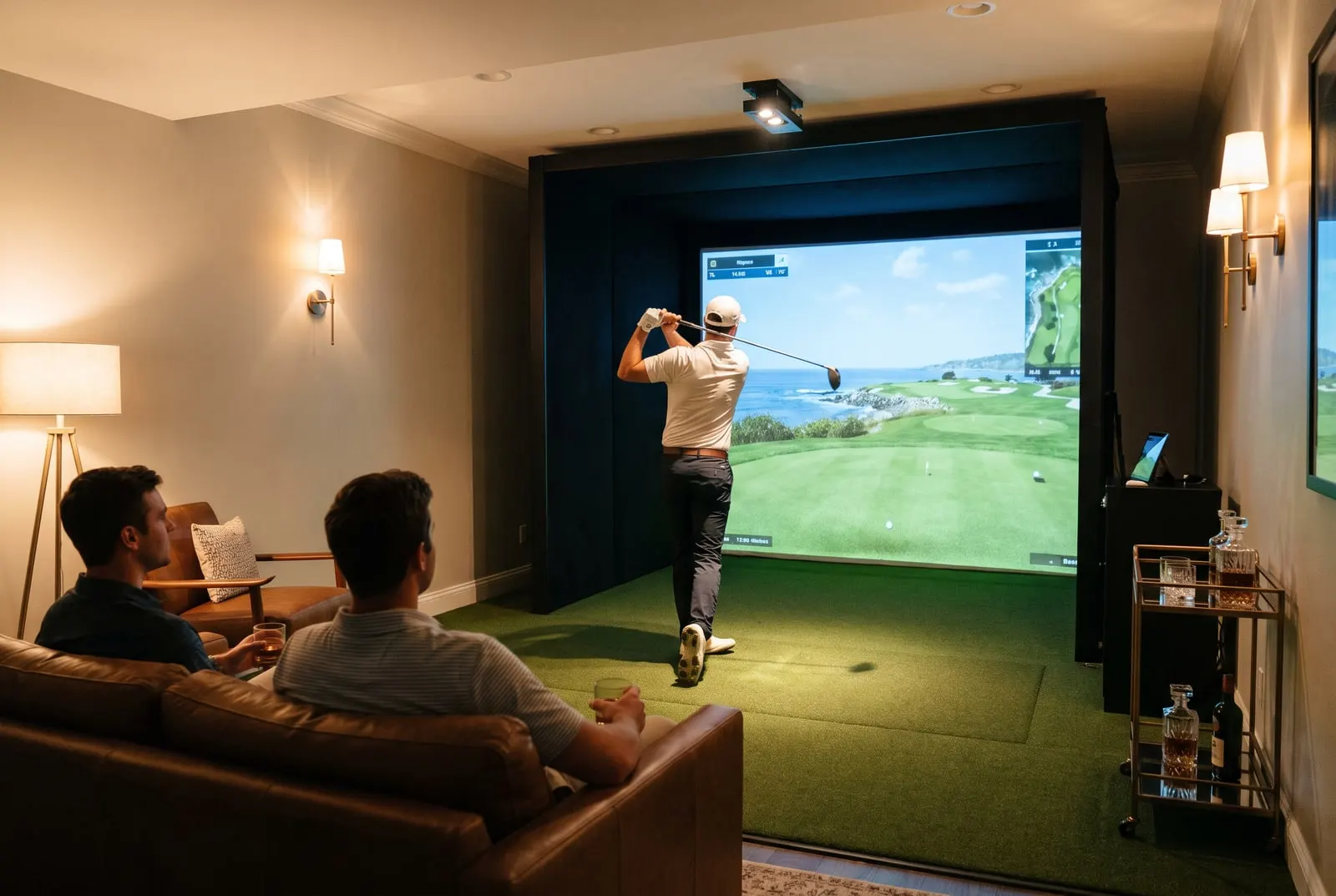
This is where the screen and projector show up, and the bay starts to feel like the one at the golf store. You hit into an impact screen, a tough fabric screen with the course projected onto it. A short-throw projector, one that makes a big picture from only a few feet away, puts the course there. A gaming PC runs GSPro or E6 Connect.
Your launch monitor choice is the SkyTrak+ or the Bushnell Launch Pro. The total runs $3,000 to $7,000 all in, depending on the screen and the PC.
The SkyTrak+ ($1,800–$3,000) is our value pick for a complete bay. It pairs a camera with a small radar, so it reads club data (how the club moves through impact) as well as ball data. GSPro, E6 Connect and TGC 2019 all run on it. Closeout prices under $2,000 showed up in 2026 when the ST MAX arrived. That makes it the cheapest way into a real bay.
Budget for the Game Improvement plan too, at around $250 a year. It turns on simulator play and third-party software.
The Bushnell Launch Pro ($2,500–$4,000) is a Foresight GC3 in Bushnell clothing. It has three high-speed cameras beside the ball and tour-level accuracy. A yearly plan decides how much data and which software you see: Silver is around $200 a year and Gold around $500.
If you want the most accurate numbers under $5,000, the Launch Pro is the one. But at the top of its price range plus a Gold plan, it pushes this tier to its $7,000 ceiling.
| Part | Pick | Price band |
|---|---|---|
| Launch monitor | SkyTrak+ or Launch Pro | $1,800–$4,000 |
| Impact screen with frame | Screen and frame kit, or a basic enclosure | $600–$3,000 |
| Projector | Short-throw, 1080p | $700–$2,000 |
| Gaming PC | Mid-range graphics card for GSPro | $900–$2,000 |
| Hitting mat | Full stance mat with a replaceable strike strip | $150–$900 |
| Software | Launch monitor plan plus GSPro or E6 Connect | $0–$700 a year |
| Total | $3,000–$7,000 all in; the $3,000 end means a closeout SkyTrak+, a screen on a frame instead of an enclosure, and a laptop you already own |
Who’s it for? A golfer who’ll play two or more evenings a week through the winter. You’ll need a room at least 10 ft wide, 13 ft deep and 9 ft high.
Who should skip it? If your ceiling is under 9 ft, read our space guide first. If you refuse to pay a subscription, look at the GC3 in the next tier. Then price your version in the cost builder.
Full bay, $8,000–$15,000: a bay you won’t outgrow
At this level the launch monitor stops being the compromise. You buy a unit with full club data. You put it in a proper enclosure (the frame and black side panels that catch stray shots) with a tight screen. You lay turf across the floor. And you pick a projector that fills a 16:9 or 4:3 screen without a shadow.
Three units sit here, and the shape of your room picks between them.
The Foresight GC3 ($6,500–$7,500) is the Launch Pro with the club data and FSX software paid for once. There’s no yearly fee for the data. It sits beside the ball, so it fits a short room. We’d pick it if you want the Launch Pro’s accuracy and never want to think about a plan again.
The Full Swing KIT ($4,000–$5,000) is a radar with a touchscreen built in and 16 data points. Full Swing says it was developed with Tiger Woods. It’s our pick for a radar bay, and it costs less than the GC3.
The catch is that the KIT needs 8 ft behind the ball. So the room has to be 16 ft deep with a net, or 17 with a screen. The KIT itself needs no subscription, but the Full Swing Golf software is a separate purchase.
The Uneekor EYE MINI ($3,000–$4,500) is a portable version of Uneekor’s overhead system. It keeps the club-impact video the brand is known for. Some software features and third-party links need a yearly plan, so it ranks behind the other two. Still, it’s the cheapest way into this tier if impact video matters to you.
| Part | Pick | Price band |
|---|---|---|
| Launch monitor | GC3, Full Swing KIT or EYE MINI | $3,000–$7,500 |
| Enclosure | Premium enclosure with a tight screen and side walls | $3,000–$8,000 |
| Projector | Short-throw, 4K or a bright 1080p | $700–$2,000 |
| Gaming PC | High-end graphics card | $900–$2,000 |
| Hitting mat and turf | Premium mat, with turf across the bay if you want it | $500–$2,900 |
| Software | GSPro, E6 Connect, FSX Play courses or Full Swing Golf | $0–$700 a year |
| Total | $8,000–$15,000 plus software |
Who’s it for? A golfer with the room who plays with friends and wants numbers worth taking to a lesson.
Who should skip it? If your room fails the depth check for the KIT, take the GC3 or EYE MINI instead. And if you’d rather spend the enclosure money on a golf trip, that’s fair. Our enclosure hub covers screens and frames, and the cost builder prices the full bay.
Commercial grade, from $14,000: tour gear at home
The top tier is the gear you’d find in fitting studios and indoor golf centers. It starts at $14,000 for a TrackMan iO on its own, and a built bay runs $20,000 and up.
A TrackMan ($14,000–$25,000) measures everything the tour measures. It runs TrackMan Performance Studio and TrackMan Virtual Golf. The indoor-only TrackMan iO starts at $13,995. The TrackMan 4 has two radars, works outdoors too, and sits above $20,000.
On top of that, the simulator software costs around $1,100 a year. Like the KIT, a TrackMan needs 8 ft behind the ball, so plan on 16 ft with a net or 17 with a screen.
Full Swing and Foresight both sell complete, built-to-order bays if you don’t want to put one together yourself. Full Swing’s packages pair its own tracking with an enclosure, screen, projector and PC, and the company and its dealers quote the price. Our Full Swing review explains how they differ from the KIT. Foresight’s packages are built around the GC3 or GCQuad the same way.
| Part | Pick | Price band |
|---|---|---|
| Launch monitor | TrackMan iO or TrackMan 4, or a Full Swing or Foresight package | $14,000–$25,000 for a TrackMan |
| Enclosure | Premium enclosure, often custom-built | $3,000–$8,000 |
| Projector | 4K short-throw | $700–$2,000 |
| Gaming PC | High-end, often supplied with the package | $900–$2,000 |
| Turf and flooring | Full-room turf with a built-in mat | $900–$2,900 |
| Software | TrackMan yearly fee or the package software | $0–$700 a year and up |
| Total | From $14,000 for a TrackMan iO alone; $20,000 and up for a built bay |
Who’s it for? A golfer for whom budget isn’t the question, or a shared bay in a club or office.
Who should skip it? Almost everyone else. A GC3 bay gives you most of the same experience for a third of the money. The cost builder shows you how big that gap is.
The picks side by side
| Launch monitor | Price | Tracking | Sits | Room depth | Club data | Subscription |
|---|---|---|---|---|---|---|
| Square Golf Launch Monitor | $600–$700 | Camera | Beside ball | 12–13 ft | Partial | Optional |
| SkyTrak+ | $1,800–$3,000 | Camera | Beside ball | 12–13 ft | Yes | Yes, for sim play |
| Bushnell Launch Pro | $2,500–$4,000 | Camera | Beside ball | 12–13 ft | With plan | Yes, for sim play |
| Foresight GC3 | $6,500–$7,500 | Camera | Beside ball | 12–13 ft | Yes | None |
| Full Swing KIT | $4,000–$5,000 | Radar | 8 ft behind | 16–17 ft | Yes | None |
Prices are US store ranges. Room depth is wall to wall: the first number is with a net, the second with an impact screen, which needs a 1 ft gap behind it.
Every camera unit in that table needs only swing room behind the ball, about 4 ft, plus 8 ft of flight. Every radar needs 7 to 8 ft behind the ball instead.
Accuracy and club data climb with price. Subscriptions show up in the middle of the range and vanish for the GC3 and the KIT. Then they come back at the top as TrackMan’s yearly software fee.
The room decides more than the budget
It’s tempting to pick a budget, then a launch monitor, and only then measure the room. Do it the other way round. A garage with a 7 ft 6 in ceiling can’t swing a driver, whatever unit you buy. And a 13 ft deep spare room can’t fit a radar.
Our guides to simulator dimensions and the garage build walk through the measurements. The room checker tells you which units fit before you spend a cent.
Three other things move the total more than the launch monitor does:
- The screen. A tight screen in a full enclosure costs several times what a net does. It also needs a projector and a PC. So the jump from the first tier to the second is really about $3,000, not $1,500.
- Software. This is the quiet one. A Launch Pro Gold plan plus GSPro adds up to around $750 a year. A GC3 owner playing FSX pays nothing yearly.
- Turf. It’s the line people leave off the budget. A good mat on bare concrete looks unfinished, and turf ($0–$2,000) is the usual fix.
For each part, see our picks for the best impact screens, best projectors and best hitting mats.
What to buy first
Not sure which tier you’re in? Buy the launch monitor first and the net second, then play on a laptop for a month. A Square Golf or SkyTrak+ you buy now still works in a full enclosure later, so nothing goes to waste.
If that month says you’ll play three nights a week, add the screen, projector and PC. If it says you’ll play twice a month, you’ve just saved $4,000.
Then run your room through the room checker, price your tier in the cost builder, and read the review for your unit. Starting with a Garmin R10? Our R10 simulator setup guide lists everything else you need.
Questions people ask
How much does a good home golf simulator cost?
A garage starter (a launch monitor, a net and a mat, played on your phone) runs $700–$1,500. A serious home bay with a screen, projector and PC runs $3,000–$7,000 with a SkyTrak+ or Launch Pro. A full bay with a GC3 or Full Swing KIT in a premium enclosure runs $8,000–$15,000.
What is the best golf simulator for a small room?
Pick a camera unit that sits beside the ball, like the Square Golf, SkyTrak+, Launch Pro or GC3. They only need swing room behind you. A radar like the Garmin R10 or Full Swing KIT sits 7 to 8 ft behind you, on top of 8 ft of ball flight. That rules out rooms under 15 ft deep with a net.
Do I need a projector and screen, or will a net and a TV work?
A net and a TV work fine, and they're the cheaper place to start. You lose the feel of hitting at a fairway, but you keep $1,500 to $5,000. Add the screen and projector later, once you know you'll use the bay every week.
Which home golf simulators have no subscription?
The Foresight GC3 and Full Swing KIT include their data with no yearly fee. The Garmin R10 and Square Golf give you ball data for free. The SkyTrak+ and Launch Pro need a plan for simulator play, and TrackMan charges a yearly software fee.
Keep reading
- The best budget golf simulators (under $1,000 to $3,000)What a cheap golf simulator really gets you at $800, $1,500 and $3,000, the five units worth buying, and what marketplace bargains usually turn out to be.Best-of listRead it
- What a golf simulator really costsReal price ranges for every budget, plus a builder that adds up your own setup.SectionRead it
- How much space do you need for a golf simulator?The ceiling, depth and width a home golf simulator needs, in feet and inches, with minimum and comfortable sizes and which launch monitors fit which rooms.GuideRead it
- The best golf launch monitors for a home simulatorNine launch monitors ranked for a home simulator, from a $200 range radar to a $7,000 camera, with the room each needs and what it costs over three years.Best-of listRead it
- Full Swing golf simulator review: the KIT and the full packagesWhat the Full Swing KIT measures, what the software and built-to-order bays add, the 16 to 17 ft room it needs, and the cheaper units to weigh against it.ReviewRead it
- Garmin R10 simulator setup: everything you need beyond the R10How to build a Garmin R10 simulator step by step: the room it needs, the mat, net or screen, phone or PC, software, projector or TV, and what three builds cost.GuideRead it