How much space do you need for a golf simulator?
The ceiling, depth and width a home golf simulator needs, in feet and inches, with minimum and comfortable sizes and which launch monitors fit which rooms.
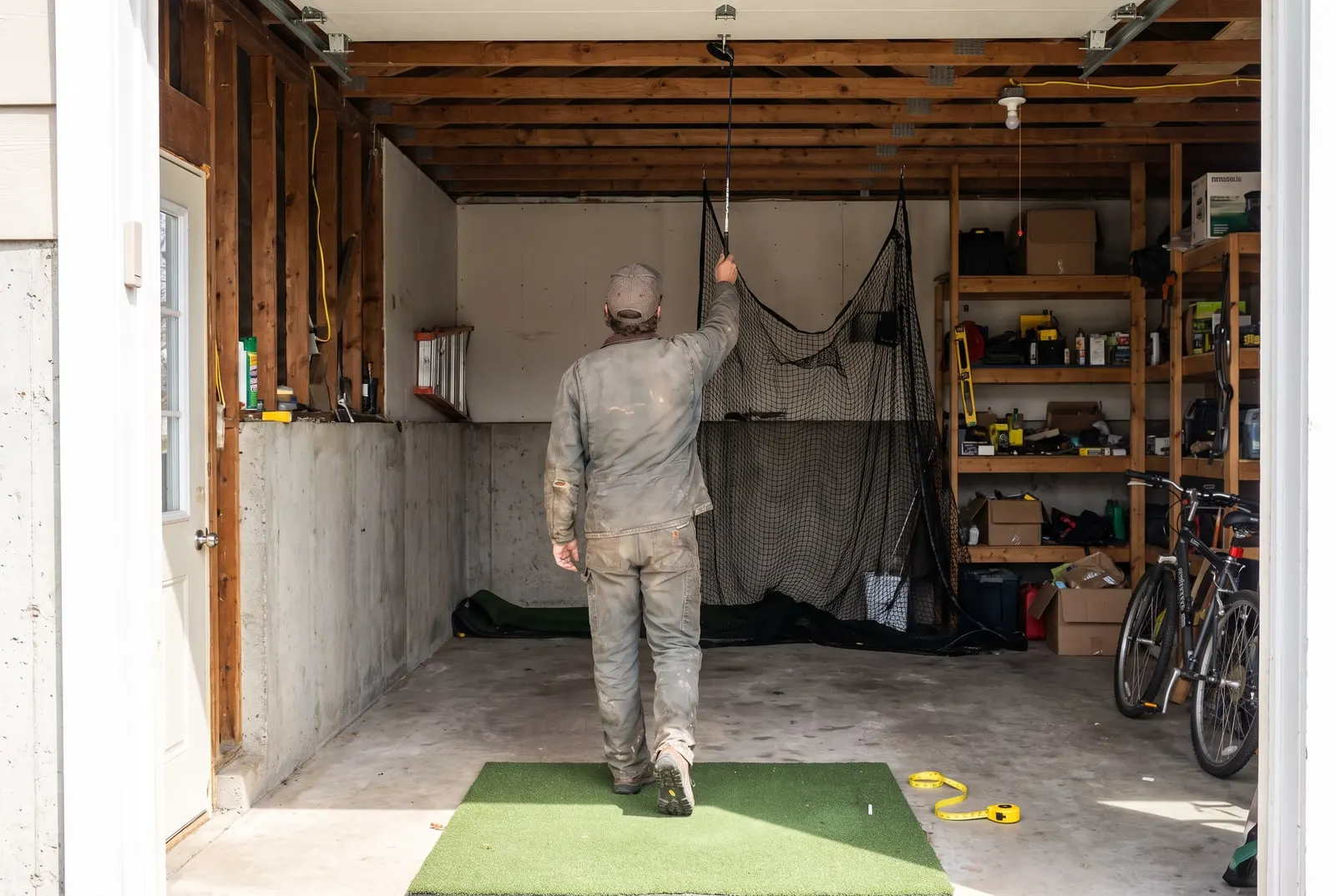
Key takeaways
- Plan on a 9 ft ceiling to swing a driver (10 ft is comfortable), a room at least 10 ft wide, and 12 to 17 ft of depth, depending on the launch monitor.
- Depth is the space behind the ball, plus 8 ft of ball flight, plus 1 ft behind an impact screen. A net can hang on the wall with no gap.
- Camera units beside the ball, like the Square Golf, need 12 ft of depth with a net or 13 with a screen. Radars like the Garmin R10 need 15 and 16 ft.
- Under 8 ft 6 in, it's an irons-only room. A 10 ft wide room suits one golfer and a net. A lefty and a righty sharing the bay need 12 ft.
On this page
Most home golf simulators need a 9 ft ceiling, a room 10 ft wide, and 12 to 17 ft of depth. Where you land in that depth range depends on two things. One is the launch monitor, the gadget that measures your shot. The other is whether you hit into a net or a screen.
Read this before you spend a dollar. Got your tape measure out already? Put your numbers into the room checker and it’ll tell you which launch monitors and setups fit.
Ceiling height comes first
Start with the ceiling, because nothing you buy can fix a low one. A short room can take a different launch monitor. A narrow room can take a net. But a low ceiling takes the driver out of your hands, and a simulator without a driver is a very expensive chipping net.
Is your ceiling high enough for a driver?
Measure to the lowest thing over your swing, not the flat ceiling.
Irons only
Or a much flatter swing. A driver hits the ceiling for most golfers.
Maybe, for some swings
Works for shorter golfers and flatter swings. Test your own swing before you buy.
The practical minimum
A driver works for most golfers
Comfortable
Room for a full swing, a ceiling projector and a frame. Over 6 ft 2 in, or an upright swing? Plan on more than 10 ft.
Under 8 ft 6 in
Irons only
Or a much flatter swing. A driver hits the ceiling for most golfers.
8 ft 6 in to 9 ft
Maybe, for some swings
Works for shorter golfers and flatter swings. Test your own swing before you buy.
9 ft to 10 ft
The practical minimum
A driver works for most golfers
10 ft and up
Comfortable
Room for a full swing, a ceiling projector and a frame. Over 6 ft 2 in, or an upright swing? Plan on more than 10 ft.
Treat those as starting points. Your height, your posture and how steeply you take the club back all change where the clubhead peaks.
Measure to the lowest thing along the swing, not to the flat part of the ceiling. Light fittings, ducts, a beam, a garage door track and an opener motor all count. If one of them hangs over the mat or over the top of your backswing, that’s your real ceiling height.
Depth decides which launch monitor you can buy
Depth is the length of the room in the direction you hit, from the wall behind you to the wall the screen hangs on. Three things have to share it:
- The space behind the ball. A radar sits here, and your swing needs some of it anyway.
- The ball flight. That’s the gap from the ball to the screen or net. Most makers ask for about 8 ft, so the unit sees enough of the flight to read it.
- The gap behind an impact screen. About 1 ft, so a drive doesn’t push the screen into the wall and bounce back at you. A net needs no gap.
The big difference is where the launch monitor sits. A radar unit sits behind you and tracks the ball as it flies, like the speed gun at a baseball game. A camera unit sits beside the ball and takes super-fast photos right at impact.
The Square Golf, Bushnell Launch Pro, SkyTrak+, Foresight GC3 and Uneekor EYE MINI are all camera units. They sit a foot or two to the side of the mat. So the only space you need behind you is about 4 ft of swing room.
A camera unit beside the ball, like the Square Golf
13 ft wall to wall with an impact screen, 12 ft with a net.
4 ftswing room
8 ftball flight
1 ftgap
That short room is why the Square Golf keeps turning up in spare-room builds. Radars need a lot more. The Garmin R10 and Rapsodo MLM2PRO want about 7 ft behind the ball.
A radar behind you, like the Garmin R10 or MLM2PRO
16 ft wall to wall with an impact screen, 15 ft with a net.
7 ftradar behind you
8 ftball flight
1 ftgap
The FlightScope Mevo Gen2 and Full Swing KIT want about 8 ft behind the ball. That adds a foot: 16 ft with a net, 17 with a screen. For any radar, we’d call 18 ft comfortable. And if your room is under 15 ft deep, the Garmin R10 review tells you to skip it.
Picking a net over a screen saves exactly 1 ft. The net can hang flat on the wall, but the launch monitor still wants its 8 ft of ball flight.
Width is about where your misses go
Width matters less than ceiling and depth. It’s also the one people skimp on. A 10 ft room looks plenty wide until a pulled hybrid finds the side wall.
How wide does the room need to be?
Too narrow
Below the minimum, even for a net
One golfer and a net
Hit from one side into a net or a narrow enclosure. Side netting is tight.
Lefties and righties
Both can hit from the middle of the mat. A 10 ft enclosure fits with 1 ft of walking room each side.
Comfortable
A full enclosure with side netting, room to stand behind the golfer, and space for the PC and a chair
Under 10 ft
Too narrow
Below the minimum, even for a net
10 ft to 12 ft
One golfer and a net
Hit from one side into a net or a narrow enclosure. Side netting is tight.
12 ft to 15 ft
Lefties and righties
Both can hit from the middle of the mat. A 10 ft enclosure fits with 1 ft of walking room each side.
15 ft and up
Comfortable
A full enclosure with side netting, room to stand behind the golfer, and space for the PC and a chair
An enclosure is the frame and black side panels around the screen that catch stray shots. Store-bought ones run about 8 to 10 ft tall, 10 to 16 ft wide and 3 to 5 ft deep. Measure the one you like against your room before you fall for it. A 10 ft wide enclosure in a 10 ft wide room touches both walls, and you can’t walk around it.
A net setup and a screen setup need different rooms
You can run the same launch monitor two ways. One is a hitting net with a TV on the wall. The other is an impact screen (the tough fabric screen you hit into) with a projector showing the course on it.
Both need about 8 ft of ball flight and a 9 ft ceiling for a driver. Here’s where they differ:
- Gap behind. A net needs none, because it soaks up the ball. A screen needs about 1 ft so the ball doesn’t hit the wall through it.
- Width. A net is fine in 10 ft. A 10 ft screen needs 12 ft of width.
- Ceiling. A screen also needs room overhead for the projector mount.
- Noise. A net is quiet. A ball hitting an impact screen is loud, and a loose screen is louder.
- What you see. With a net, you watch the shot on a TV off to the side. With a screen, you see it right where you hit it, which is most of the fun.
A net build is a smart first step for a lot of rooms, and it’s the setup in our budget simulator list. Going straight to a screen? The enclosure and screen guides cover the frames and fabrics. The DIY build order shows how to put one together without the usual mistakes.
Minimum and comfortable sizes
Here’s the table to carry into the room with you.
| Measurement | Minimum | Comfortable | Notes |
|---|---|---|---|
| Ceiling | 9 ft (8 ft 6 in for irons only) | 10 ft or more | Measure to the lowest obstacle, not the drywall |
| Depth, camera unit beside the ball | 12 ft with a net, 13 with a screen | 14 to 16 ft | 4 ft swing room, 8 ft flight, 1 ft behind a screen |
| Depth, radar unit behind the ball | 15 ft with a net, 16 with a screen (16 and 17 for the Mevo Gen2 and KIT) | 17 to 18 ft | 7 to 8 ft behind the ball, 8 ft flight, 1 ft behind a screen |
| Width, net | 10 ft | 12 ft | One golfer, hitting from the middle of the mat |
| Width, enclosure | 12 ft | 15 ft | Fits a 10 ft screen and side netting |
“Minimum” means it works, with no spare room for a low projector, a tall golfer or a second player. “Comfortable” leaves room for all three. Somewhere in between? It’ll work, with a compromise or two. The room sizes page walks through four common rooms and what each one gives up.
Which launch monitors fit which rooms
Your depth is the fastest way to shortlist a launch monitor. This table uses each maker’s placement advice, rounded to whole feet. It adds 1 ft behind a screen (a net needs none) and, for camera units, 4 ft of swing room. Prices are typical US ranges.
| Launch monitor | Sits | Behind the ball | Ball flight | Room depth needed | Price range |
|---|---|---|---|---|---|
| Garmin R10 | Behind, radar | About 7 ft | 8 ft | 15 ft with a net, 16 with a screen | $500–$600 |
| Rapsodo MLM2PRO | Behind, radar | About 7 ft | 8 ft | 15 ft with a net, 16 with a screen | $600–$700 |
| Square Golf | Beside, camera | Swing room only, about 4 ft | 8 ft | 12 ft with a net, 13 with a screen | $600–$700 |
| SkyTrak+ | Beside, camera | Swing room only, about 4 ft | 8 ft | 12 ft with a net, 13 with a screen | $1,800–$3,000 |
| Bushnell Launch Pro | Beside, camera | Swing room only, about 4 ft | 8 ft | 12 ft with a net, 13 with a screen | $2,500–$4,000 |
| FlightScope Mevo Gen2 | Behind, radar | About 8 ft | 8 ft | 16 ft with a net, 17 with a screen | $1,300–$2,300 |
| Full Swing KIT | Behind, radar | About 8 ft | 8 ft | 16 ft with a net, 17 with a screen | $4,000–$5,000 |
Here’s what that tells you:
- Under 15 ft deep (but at least 12 ft with a net, 13 with a screen), a camera unit is the only sensible pick. The Square Golf is the cheapest way in.
- From 15 ft with a net, or 16 with a screen, the R10 and MLM2PRO become the cheapest route to simulator golf. They lead our list of launch monitors under $1,000.
- Past that, the room stops being the limit and your budget takes over. Our best launch monitors ranking is sorted that way.
No room for ball flight at all? The OptiShot 2 reads the clubhead from an infrared mat, so the ball never has to fly. It’s more game than practice tool. But you can play it with short irons in a basement with an 8 ft ceiling.
Garages, basements and spare rooms
Garages have the depth, since a single bay runs 20 to 24 ft. The catch is the door track and opener motor, which hang right where you want to swing. The garage simulator guide shows where to put the bay so you clear the track, and how to deal with the cold.
Basements have the depth and the width, but the ceiling is the problem. Many are 7 ft 6 in to 8 ft between the joists, with ducts hanging lower still. Do the slow swing check before you measure anything else.
Spare rooms are the opposite: a fine ceiling on a 10 by 12 ft floor. That’s a camera-unit room, with a net or a compact screen. The dimensions page has a worked plan for it, and the other room guides go deeper on each kind of space.
Check your room now
Write down three numbers: the ceiling at its lowest point over the swing, the depth from back wall to screen wall, and the width. Put them into the room checker. It’ll tell you which launch monitors fit, whether a screen or a net makes sense, and how much room you have to spare. Then the cost builder will price the build that fits.
Questions people ask
Can you fit a golf simulator under an 8 ft ceiling?
Usually only for irons and wedges. A driver needs about 9 ft of ceiling to keep the clubhead off it, though a shorter golfer or a flatter swing can sometimes get by with 8 ft 6 in. Under 8 ft, plan on mid-irons down, or a club-reading mat like the OptiShot 2 that doesn't need the ball to fly.
How much space do you need behind the ball for a golf simulator?
It depends on the launch monitor. Radars sit 7 to 8 ft behind the ball (about 7 ft for the Garmin R10 and Rapsodo MLM2PRO), so you need that much plus a little margin to the back wall. Camera units like the Square Golf, SkyTrak+ and Bushnell Launch Pro sit beside the ball, so you only need about 4 ft behind you to swing.
What size room do you need for a Garmin R10?
Garmin asks for about 7 ft behind the ball and about 8 ft of ball flight. That's 15 ft of depth with a net, or 16 ft with an impact screen and the foot of gap it needs. We'd call 18 ft comfortable, with a 9 ft ceiling and at least 10 ft of width.
Is a 10 ft wide room enough for a golf simulator?
Yes, for one golfer hitting from one side into a net or a compact enclosure. You can't hit from both sides, and a 10 ft enclosure will touch both walls. If a lefty and a righty share the bay, 12 ft is the practical minimum.
Keep reading
- Golf simulator dimensions: room sizes that work, with a plan for eachFour golf simulator room plans, from a 10 by 12 ft spare room to a 15 by 20 ft dedicated bay, with where the mat, launch monitor and projector go.GuideRead it
- Garage golf simulator: how to plan a bay around the door, the car and the coldHow to fit a golf simulator in a garage: the door track, one bay or two, which way to hit, heat, light, dust, and what a budget or full build costs.GuideRead it
- The best golf launch monitors for a home simulatorNine launch monitors ranked for a home simulator, from a $200 range radar to a $7,000 camera, with the room each needs and what it costs over three years.Best-of listRead it
- The best budget golf simulators (under $1,000 to $3,000)What a cheap golf simulator really gets you at $800, $1,500 and $3,000, the five units worth buying, and what marketplace bargains usually turn out to be.Best-of listRead it
- DIY golf simulator: a build order that avoids the expensive mistakesHow to build your own golf simulator in the right order: measure, pick the launch monitor, then the frame, screen, mat, projector and PC, with what each costs.GuideRead it