The best golf hitting mats for a home simulator
Why cheap mats hurt, fiber vs nylon turf, how thick, what size, what camera launch monitors need from a mat, and what each price band gets you.
How we make money. If you buy through a retailer link here, we may earn a commission. It costs you nothing and doesn’t change our picks. Our affiliate disclosure.
Key takeaways
- For most permanent bays, we'd buy the SIGPRO Softy ($350 to $700). Its soft base slows a fat shot, it holds a wooden tee, and it works under a camera unit.
- A thin mat on concrete stops the club dead on a fat shot. On a garage slab, plan on at least 1 in of base with a soft layer.
- For a sore elbow, get Fiberbuilt's long-fiber strips ($400 to $900). For a garage net and nothing more, the Carl's Place HotShot ($150 to $350) will do.
- Size it for a stance about 4 ft deep by 5 ft wide, plus the hitting area. Combo mats from 4 by 7 ft to 5 by 10 ft cover both.
On this page
You’re about to hit a few thousand balls a year off the same patch of turf. You want to do it without a sore elbow, and without a launch monitor that misreads every third shot. That’s what this page is for.
We’ll cover what a $700 mat gets you over a $120 one, and which turf holds a real tee. We’ll also cover what a camera launch monitor needs from the surface it watches. The rest of the bay lives in the guides to impact screens and enclosures and projectors. The enclosure guide shows how it all fits together.
Why a cheap mat costs more than it saves
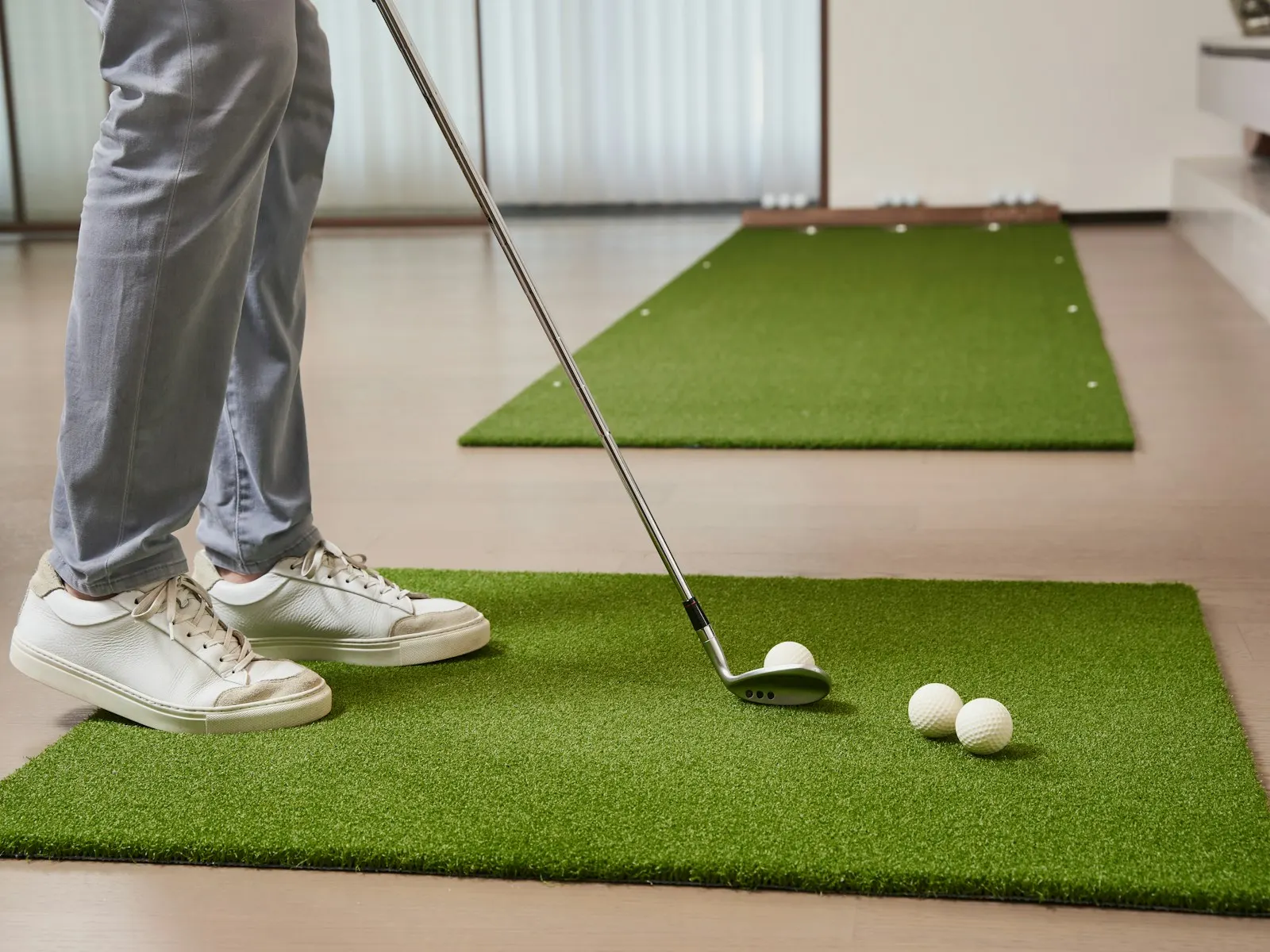
A cheap hitting mat is a thin sheet of nylon turf glued to a slab of hard foam. Two things go wrong with it.
Your body takes the hit. On grass, a fat shot digs a divot and the club keeps moving. On a thin mat over concrete, the club has nowhere to go. It stops in a fraction of an inch, and the shock runs into your wrists and up to your elbow. One fat shot does nothing. Hundreds a week, all winter, is how a lead elbow gets sore.
Your game gets fooled. That same hard surface lets the club skid into the ball on a fat shot. The ball launches almost normally, so the simulator shows a decent number. Then you take that fault outdoors in April, and the same swing digs a trench. A good mat gives the club somewhere to go, so a fat shot feels fat and flies like one.
The mats that fix both problems cost more. They have more padding under the turf, and turf that moves.
Fiber turf versus nylon turf
Nylon turf is the short, thick, carpet-like surface on most mats. It’s tough and cheap, and it’s the surface that causes the skid. Standard nylon mats also wear a shiny patch where you hit after a few months. That matters if you own a camera launch monitor (more on that below).
Fiber turf is long, soft, separate strands set into a base. That’s how Fiberbuilt builds its hitting strips. The fibers bend under the clubhead and spring back, so the club slows down on a heavy strike. A wooden tee pushes straight in and stays. The catch? Fiber strips wear out and need replacing every year or two of heavy use, and they cost more.
In between sit dense long-pile nylon mats like the Real Feel Country Club Elite. The tall, thick pile holds a wooden tee and lets the club move through it. They’re heavy and they last, and they feel closer to a firm fairway.
Long-fiber mats you can tee into
If you hit driver indoors, this choice matters more than the brand. A mat that takes a wooden tee lets you tee up at any height, the way you do on the course. A mat with a rubber tee gives you two or three set heights in one spot.
Fiberbuilt’s fiber strips, the Real Feel Country Club Elite and the SIGPRO Softy all hold a wooden tee. The budget nylon mats mostly don’t.
Thickness and shock pads
Mats run from about half an inch thick on a budget turf mat to 2 in or more on the premium pads. What’s inside that thickness matters as much as the number.
A foam base of about 1 in is the minimum for regular use on concrete. It takes some of the shock and stops the mat from sliding. A thicker or softer base, or a separate shock pad under the mat, takes more. On a garage slab, plan on at least 1 in with a soft layer.
Each brand fixes the shock problem its own way:
- TrueStrike puts a gel-filled section under the hitting zone. The clubhead sinks in, then it bounces back. A firmer stance section goes around it.
- Fiberbuilt’s strips are the shock absorber themselves. The club slows down in the fibers, not against the base.
- The SIGPRO Softy uses a softer base layer than standard mats, which is where the name comes from.
Sizes: the stance and the hitting strip
Measure two things: where your feet go, and where the ball goes.
The stance area needs to be about 4 ft deep (toward the screen) and 5 ft wide. That keeps both feet on the mat for a tall golfer with a driver. The hitting area needs to cover the ball and the launch monitor’s zone. For a side-camera unit, that’s roughly a 1 ft by 2 ft box around the ball.
The common sizes are:
- A 4 ft by 7 ft combo, with stance and hitting area in one piece.
- A 5 ft by 10 ft combo.
- A hitting strip set into a bigger stance mat with a cutout.
A cutout design lets you swap just the worn strip. A one-piece mat is cheaper and easier to lay. Don’t use a hitting strip on its own with your feet on the floor. It puts the ball above your feet and changes your swing.
The DIY golf simulator page shows where the mat goes in the floor plan, next to the screen gap and the launch monitor. The room checker tells you whether a 10 ft mat even fits.
Combo mats with a putting surface
Some makers sell a combo mat with putting turf beside the hitting area, so you can putt out on the same surface. SIGPRO sells Softy combos with a putting section. Fiberbuilt and Carl’s Place offer bigger stance mats in a putting turf.
The combo is worth it if you’ll actually putt on it. If you plan to use the simulator’s auto-putt, the putting turf is just floor you paid for.
How mats affect camera launch monitors
A radar unit like the Garmin R10 sits behind you and tracks the ball in the air, so it doesn’t care much about the mat. A camera unit does. It sits beside the ball and takes super-fast photos right at impact.
Side-mounted camera units like the Bushnell Launch Pro and the SkyTrak+ watch the ball from a few inches above the mat. Three mat problems show up in their numbers:
- Shiny turf. A worn, shiny nylon patch under bright lights throws glare at the camera. The unit can miss the ball or read a bad launch angle. Matte fiber and dense long-pile turf avoid this.
- Ball height. On long fiber, the ball can sink into the strands and sit lower than the camera expects. Find a steady spot and keep the ball there. Also check the maker’s help pages for mats it warns about.
- Lines and patterns. Alignment lines on the stance area are fine. A bold white grid right in the camera’s view can confuse some units. A plain hitting strip under the ball is the safe setup.
If your launch monitor is on the best launch monitors list, read its review for mat advice before you buy.
Tees for mats
Long-fiber and dense long-pile mats take a wooden tee at any height. Thin turf mats need a rubber tee that fits through a hole, sold in heights from about 1 in to 3 in. With a thin mat, buy a pack of mixed-height rubber tees. With a fiber mat, you don’t need anything extra.
What the bands cost
What a hitting mat costs
US retail bands, approximate.
Budget
$100 to $250
Mid
$250 to $500
Premium
$500 to $900
Here’s what each band gets you, and who it suits.
| Band | What you get | Who it suits |
|---|---|---|
| Budget | Nylon turf on foam, often a rubber tee, around 3 ft by 5 ft | A net in the garage, now-and-then use, a first build |
| Mid | Softer base or a fiber strip, stance plus hitting area, holds a tee | Regular indoor practice, most home simulators |
| Premium | Thick pad or gel, swappable strip, large stance mat, putting combos | Daily use, sore joints, a camera launch monitor |
Shipping a 5 ft by 10 ft mat isn’t cheap, and some shops charge it separately. Add the mat to the cost builder with the rest of the build.
The picks
| Pick | Maker and line | Turf type | Holds a wooden tee | Price (approximate) |
|---|---|---|---|---|
| Best overall | SIGPRO Softy (The Indoor Golf Shop) | Dense turf on a soft base | Yes | $350 to $700 |
| Best budget | Carl’s Place HotShot | Nylon turf on foam | Rubber tee | $150 to $350 |
| Best for joints | Fiberbuilt (Player’s Preferred and Studio lines) | Long fiber strips | Yes | $400 to $900 |
| Best large stance mat | TrueStrike (modular stance and gel hitting section) | Nylon over gel | Rubber or wooden, by section | $500 to $900 |
Best overall: SIGPRO Softy (The Indoor Golf Shop)
The Softy is The Indoor Golf Shop’s own mat. Its turf is thick but forgiving, over a soft base layer. On a fat shot the club slows down instead of skidding, and it takes a wooden tee. It’s sold as a one-piece combo mat in several sizes, and in combos with a putting section.
Who’s it for? You’re building a permanent bay and want one mat for both your stance and the strike. It works under a camera launch monitor without glare, and you won’t need a new strip every year.
Skip it if you want the softest landing for a bad elbow, because Fiberbuilt and TrueStrike give more. Skip it too if your budget is under $300.
Price: $350 to $700, depending on size and putting combo (approximate).
Best budget: Carl’s Place HotShot
The HotShot is Carl’s Place’s starter mat. It’s nylon turf over a foam base, in a few stance-plus-hitting sizes, at a price that leaves money for the screen. It feels better than the no-name mats, and the turf lasts longer before it goes shiny.
It suits a garage net, a first build on a tight budget, or a second mat for a chipping corner.
Skip it if you hit driver indoors a lot, because you’ll want a mat that holds a real tee. Skip it if your elbow or wrist already hurts. And skip it if you own a camera unit that’ll be staring at a shiny hitting spot in a year.
Below it sit the Rukket-style three-turf mats from the big online stores, which cost $100 to $200 and are fine for a net, not for a daily simulator.
Price: $150 to $350, depending on size (approximate).
Best for joints: Fiberbuilt (Player’s Preferred and Studio lines)
Fiberbuilt builds its mats around long, soft fiber strips set into a stance mat. On a fat shot the clubhead goes through the fibers and slows down. A wooden tee pushes in anywhere, and the strike feels more like turf than carpet. The Player’s Preferred and Studio lines are the home versions. They come in combo sizes up to around 10 ft long, with a swappable strip in the stance area.
It suits you if your elbow or wrist is sore, if you practice daily, or if you want the simulator to punish a heavy strike.
Skip it if you want the firmest, most fairway-like strike. The Real Feel Country Club Elite is the mat for that. Skip it too if swapping the strip every year or two bugs you. And if you own a camera launch monitor, check what its maker says about long fiber first.
Price: $400 to $900, depending on size (approximate).
Best large stance mat: TrueStrike (modular stance and gel hitting section)
TrueStrike sells its mat in modules, like puzzle pieces. There’s a hitting section with gel underneath, and stance sections that lock onto it to make the mat as wide or long as you need. The gel saves your joints. The modules let you build a big stance.
You can run a mat the full width of a 10 ft enclosure and put the hitting section wherever the launch monitor wants it. When the turf wears, you replace only that one module.
It suits a bay where the mat has to cover a big area. It also suits a side-camera unit that needs the hitting spot in one exact place. It’s also a good fix for sore joints if you like a firmer turf feel than Fiberbuilt’s strips.
Skip it if you want a one-piece mat you can lay and forget, or if your budget stops at the mid band. The modules add up fast in a big bay. The seams between them can also catch a putter or a foot.
Price: $500 to $900 for a hitting section plus stance modules, more for a full-width bay (approximate).
Also consider the Real Feel Country Club Elite. It’s the dense long-pile nylon mat to look at if you want the firmest, longest-lasting strike that still holds a wooden tee. It’s heavy, and it sits between the mid and premium bands.
Which one to buy
For most permanent bays, buy the SIGPRO Softy in the biggest size the room takes. For a sore elbow, buy Fiberbuilt. For a big enclosure where the mat has to reach wall to wall, buy TrueStrike modules. For a net in the garage and nothing more, the Carl’s Place HotShot does the job.
Before you order
- Tape out the stance. Mark a box about 4 ft deep by 5 ft wide on the floor where you’ll stand.
- Mark the ball spot. Put it where your launch monitor wants the ball, and check the mat covers it.
- Check your camera unit. Make sure its maker hasn’t warned against the mat you picked.
- Finish the bay. Pick the screen in the impact screen guide and the projector in the projector guide.
Questions people ask
Why does my golf mat hurt my elbow?
A thin mat on a hard floor stops the club dead on a fat shot. The shock runs up the shaft into your wrists and elbow. Thick fiber mats and gel or foam pads let the club slow down in the turf instead. If it already hurts, change the mat first.
Can you use a real tee on a golf mat?
Yes, on long-fiber mats like Fiberbuilt or the Real Feel Country Club Elite. You push a wooden tee into the fibers and it stays put. Thinner mats need a rubber tee that fits through a hole, in a few set heights. If you hit driver indoors a lot, buy a mat that takes a real tee.
What size hitting mat do I need for a simulator?
You need a stance area about 4 ft by 5 ft so both feet sit level with the ball. Add a hitting area big enough for the launch monitor, about 1 ft by 2 ft for most units. Combo mats from 4 by 7 ft up to 5 by 10 ft cover both. A small strip on a bare floor leaves your feet lower than the ball.
Keep reading
- The best golf impact screens and enclosuresScreen only, frame or full enclosure: how to pick a golf impact screen, how much gap it needs behind it, sizes, noise and what each type costs.Best-of listRead it
- The best projectors for a golf simulatorHow to pick a golf simulator projector: why short-throw matters, throw ratio made simple, how bright for a garage, 1080p vs 4K, and what each band costs.Best-of listRead it
- DIY golf simulator: a build order that avoids the expensive mistakesHow to build your own golf simulator in the right order: measure, pick the launch monitor, then the frame, screen, mat, projector and PC, with what each costs.GuideRead it
- Bushnell Launch Pro reviewWhat the Bushnell Launch Pro measures, how the Silver and Gold plans change what you see, the room it fits, and who should pay for it.ReviewRead it